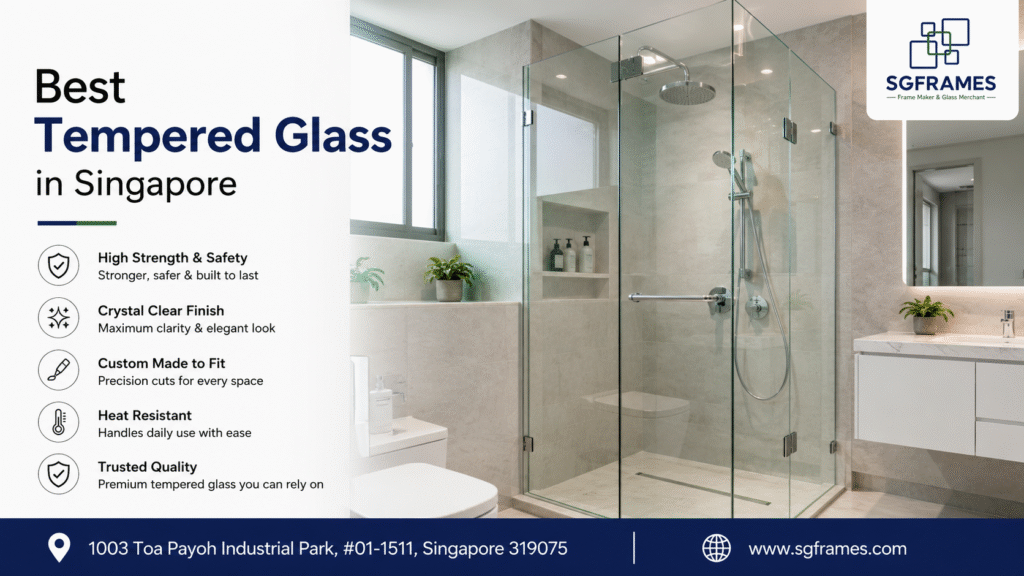
If you’re comparing options for the best tempered glass in Singapore, you’ve probably noticed that most listings look the same vague promises, no real specification detail, and no explanation of what actually makes one supplier more reliable than another. This guide fixes that. It walks through what tempered glass is, where it’s used, how Singapore’s safety standards apply, and what to check before you commit to a supplier. It’s written from the working experience of SG Frames, a Singapore glass and framing company that has spent years fabricating and installing glass for households, government agencies, and commercial clients across the island.
By the end, you’ll know exactly what to look for whether you need a tempered glass shower screen, a table top, a shopfront panel, or a full glazing package for a new build.
What Is Tempered Glass, And Why Does Singapore Require It?
Tempered glass also called toughened glass Singapore buyers will see on spec sheets is ordinary annealed glass that has been reheated to roughly 650°C and then cooled rapidly with jets of air. This rapid cooling locks compressive stress into the surface of the glass while the core remains in tension.
The result is a pane that is four to five times stronger than standard annealed glass of the same thickness. Just as important, when it does break, it doesn’t shatter into long, sharp shards. It fractures into small, blunt granules which is exactly why it’s classified as a safety glass.
How Tempered Glass Is Made
The tempering process happens in three stages:
- Cutting and finishing -fabricators cut the glass to size and grind and polish all edges before tempering, since tempered glass cannot be cut, drilled, or reshaped afterward.
- Heating – .the furnace heats the cut panel to around 650°C, close to its softening point.
- Rapid cooling (quenching) – high-pressure air jets cool the outer surfaces almost instantly, while the inner core cools more slowly, creating the internal stress pattern that gives the glass its strength.
This is also why custom size tempered glass Singapore orders take longer than off-the-shelf pieces you must finalise every dimension before the glass goes into the furnace
Where Tempered Glass Is Used Across Singapore Homes and Businesses
Tempered glass shows up in more places than most people realise. Here’s a practical breakdown of the main applications.
| Application | Typical Thickness | Why Tempered Glass Is Used |
|---|---|---|
| Shower screens | 8mm–10mm | Withstands daily impact and temperature shifts from hot/cold water |
| Windows | 6mm–12mm | Impact resistance, wind load performance |
| Doors (glass entry doors) | 10mm–12mm | High-traffic durability, safety on breakage |
| Table tops | 8mm–12mm | Scratch resistance, heat tolerance, safety edges |
| Kitchen backsplashes | 6mm–8mm | Heat resistance near stoves, easy cleaning |
| Balustrades / railings | 10mm–15mm | Structural load-bearing with safety fracture pattern |
| Shopfronts / partitions | 10mm–19mm | Security, daily foot traffic, large-format panels |
Tempered Glass for Shower Screen Singapore
This is one of the highest-demand categories, especially for HDB and condo bathrooms. A tempered glass for shower screen Singapore installation needs to handle constant humidity, water pressure, and rapid temperature changes conditions that would eventually stress ordinary glass. Homeowners request frameless and semi-framed shower screens most right now, since they make compact bathrooms feel more open.
Tempered Glass for Windows Singapore
For tempered glass for windows Singapore projects, the priority is usually wind load and impact resistance, particularly for units facing open areas or higher floors. if debris ever strikes a window.
Tempered Glass for Doors Singapore
Glass entry doors for homes, offices, and retail units need to survive constant contact: hands, bags, trolleys, and the occasional accidental knock. Tempered glass for doors is the standard choice because it holds up to that wear while still meeting safety glazing requirements.
Table Top and Furniture Glass
Table top glass is one of SG Frames’ core product lines. Beyond looks, tempered glass table tops resist scratching from cutlery and hot cookware far better than untreated glass, and fabricators grind edges smooth and safety-polish them before dispatch.
Toughened Glass Singapore: How It Compares to Ordinary Glass
It’s worth being precise about terminology, since Singapore’s glass trade uses “toughened” and “tempered” interchangeably they refer to the same heat-treatment process.
Here’s how tempered/toughened glass compares to standard annealed glass:
| Property | Annealed (Ordinary) Glass | Tempered / Toughened Glass |
|---|---|---|
| Relative strength | Baseline | 4–5x stronger |
| Breakage pattern | Sharp, dagger-like shards | Small, blunt granules |
| Post-cutting modification | Can be cut/drilled after production | Cannot be cut or drilled after tempering |
| Typical use | Non-structural, low-risk areas | Shower screens, doors, balustrades, tabletops |
| Heat resistance | Lower | Higher — better tolerance of thermal shock |
The takeaway: if people will touch or walk past the glass, if it will face temperature swings, or if you’ll install it anywhere a breakage could cause injury tempered glass isn’t an upgrade it’s the appropriate material.
Custom Tempered Glass Singapore: What “Custom” Actually Means
A lot of listings use the word “custom” loosely. In practice, custom tempered glass Singapore work involves several real variables that a fabricator has to get right before the glass goes into the furnace:
- Exact dimensions – measured on-site, not estimated from a floor plan
- Cut-outs and notches – for pipes, hinges, brackets, or wall fittings
- Edge profile – flat polished, pencil edge, bevelled, or rounded
- Tint or finish – clear, frosted, tinted, or low-iron “ultra-clear” glass
- Thickness – matched to the application and load requirement
Clear Tempered Glass Singapore Options
Standard clear tempered glass Singapore stock has a faint green tint at the edges, which is normal for float glass. For applications where true colour clarity matters display cases, glass boxes, premium table tops low-iron (“ultra-clear”) tempered glass is available, though it typically costs more due to the raw material.
Tempered Glass vs Laminated Glass: Which Do You Actually Need?
People confuse these two constantly, and the right choice depends entirely on the application.
Manufacturers heat-treat tempered glass for strengthand breaks into small, blunt granules. It’s the default for shower screens, table tops, doors, and most residential glazing.
Manufacturers make laminated glass from two or more glass layers bonded with a plastic interlayer (usually PVB). When it breaks, the shards stay stuck to the interlayer instead of falling which is why installers prefer it for overhead glazing, skylights, and some balustrade applications where falling glass would be dangerous even if the pieces are blunt.
Some high-spec projects actually combine both using heat-strengthened or tempered laminated glass but for most homes and shops in Singapore, standard tempered glass covers the requirement. If you’re unsure which applies to your project, this is exactly the kind of question a fabricator should be able to answer on the spot, not redirect you to a brochure.
Caring for Tempered Glass: Maintenance Tips That Actually Matter
Tempered glass is low-maintenance compared to most building materials, but a few habits extend its life and keep it looking new.
- Clean with non-abrasive products. Standard glass cleaner and a microfibre cloth are enough; avoid scouring pads, which can micro-scratch the surface over time.
- Watch the edges. The edges of tempered glass are its most vulnerable point since the chip disrupts the internal stress pattern. If you notice edge damage, have a fabricator inspect it rather than waiting.
- Avoid sudden extreme temperature contact. Tempered glass tolerates thermal shock far better than annealed glass, but placing something like a very hot pan directly on cold glass repeatedly can still stress it over years.
- Check hardware, not just the glass. For shower screens and glass doors, hinges, brackets, and channels wear out before the glass does. Loose hardware puts uneven pressure on the panel.
- Don’t attempt DIY modifications. Any drilling, cutting, or edge-grinding after tempering will shatter the panel if you need a hole added later, you must re-fabricate it from scratch – you can’t modify it on-site.
Common Misconceptions About Tempered Glass in Singapore
A few myths come up often enough that they’re worth addressing directly.
“Tempered glass never breaks.” Untrue. It’s significantly stronger than annealed glass, not indestructible. What changes is how it breaks safely, into small granules not whether it can break.
Not all glass sold in Singapore is tempered – that’s also untrue. Builders still widely use annealed (untreated) glass in low-risk, non-structural applications. like picture framing or decorative panels where the safety-glazing requirement doesn’t apply. It’s the buyer’s responsibility to confirm which type they’re getting.
“Thicker always means safer.” Thickness matters, but it’s one variable among several panel size, support method, edge finishing, and installation quality all affect real-world safety performance. A well-specified 8mm panel can outperform a poorly installed 12mm one.
“Any handyman can install tempered glass.” Cutting and drilling can’t happen after tempering, and installation (especially for shower screens and doors) involves precise leveling and hardware alignment. Poor installation is one of the most common causes of premature glass failure not the glass itself.
How to Choose the Best Tempered Glass Supplier Singapore
Rather than relying on marketing claims, here’s a practical checklist for evaluating a tempered glass supplier Singapore company before you commit:
- SS 341 compliance – can they confirm the glass meets the safety glazing standard for your application?
- On-site measurement – do they measure in person, or just take your numbers over the phone?
- Portfolio of real installations – photos or references from past residential and commercial jobs
- Edge and cut-out capability – can they handle notches, holes, and custom profiles in-house?
- Installation team – does their own crew fit it, or do they subcontract it out?
- Turnaround transparency – tempered glass has a fixed production lead time because of the furnace process; be wary of suppliers who promise same-day custom orders
- After-installation support – who do you call if a panel needs adjustment or replacement?
A tempered glass shop Singapore business that can answer all of these directly – without vague deflection – is generally a safer bet than one that only quotes a price.
Tempered Glass Price Singapore: What Actually Affects the Cost
There’s no single fixed number for tempered glass price Singapore projects, because cost depends on several independent variables:
- Thickness – thicker glass costs more per square foot
- Size and shape – large panels and irregular shapes increase material waste and handling cost
- Edge work – polished, bevelled, or shaped edges add labour time
- Cut-outs and drilling – every hole or notch must be done before tempering, adding setup time
- Tint or coating – frosted, tinted, or low-iron glass costs more than standard clear
- Installation complexity – ground-floor shower screens install faster than high-rise balustrades
Affordable Tempered Glass Singapore Without Compromising Safety
The most reliable way to keep costs down without cutting corners on safety is to standardise where you can using common thicknesses and simpler edge profiles on anything you install in a high-traffic or public-facing area. The cheapest quote isn’t always the most affordable tempered glass Singapore option once you factor in longevity and safety compliance.
For an accurate number, the only honest answer is: get a site measurement and a written quote. Anyone quoting a firm price without seeing the space or the spec is guessing.
Why SG Frames for Tempered Glass in Singapore
SG Frames has built its glasswork practice table top glass, shower screens, frameless and framed mirrors, kitchen backsplashes, and glass boxes alongside its long-running custom framing business, which means the same fabrication and finishing standards apply across both product lines.
Real Project Experience Across Sectors
Beyond residential work, SG Frames’ project history includes work for organisations across defence, healthcare, and government sectors in Singapore including institutions like the Singapore Armed Forces, the Republic of Singapore Navy, SingHealth, and the Singapore Civil Defence Force, alongside private enterprise clients. That range matters: government and institutional clients typically require stricter documentation, tighter tolerances, and verifiable compliance which pushes fabrication standards higher across the board, including on residential and commercial glasswork.
What Separates a True Tempered Glass Expert From a Reseller
Not every business selling “tempered glass” in Singapore actually fabricates or installs it. Some are resellers who outsource both the glass processing and the installation. There’s a practical difference between the two:
- Practical, hands-on expertise means the team measuring your space is the same team (or works directly with the team) fabricating the glass so .the team catches mistakes in cut-outs, tolerances, or edge finishing before installation, not after.
- Theory-only, reseller-based expertise means measurements pass through multiple parties before reaching a factory, which increases the chance of miscommunication on dimensions, thickness, or safety spec.
Neither approach is inherently dishonest but if precision and accountability matter for your project, it’s worth directly asking any supplier whether they fabricate and install in-house or subcontract the work out.
Tempered Glass Installation Singapore: What to Expect
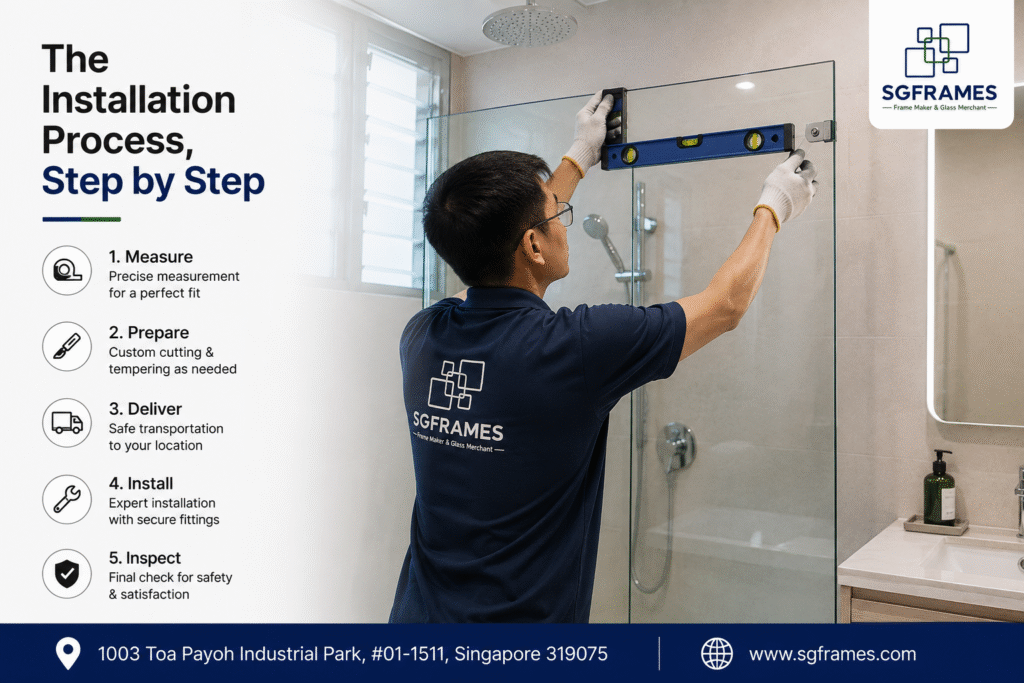
A properly run tempered glass installation Singapore job generally follows this sequence:
- Site visit and measurement the team takes exact on-site dimensions and doesn’t estimate from photos alone.
- Specification confirmation you and the fabricator finalise thickness, edge type, tint, and any cut-outs in writing
- Fabrication cutting, edge-polishing, drilling (if needed), and tempering happen in that order, since you can’t modify tempered glass afterward.
- Quality check the team inspects panels for stress marks, edge quality, and dimensional accuracy before dispatch
- Installation the installation team fits it on-site and sets hardware to level
- Final inspection the team checks for secure fit, smooth operation (for doors/screens), and finish quality
Any step skipped here especially the site measurement or quality check is where most tempered glass installation problems originate.
Frequently Asked Questions
Is tempered glass the safest type of glass for homes in Singapore? Yes. Tempered glass is classified as a safety glass because it’s significantly stronger than annealed glass and breaks into small, blunt granules rather than sharp shards, which is why which is why installers specify it for shower screens, doors, and other high-contact areas.
What Singapore standard does tempered glass need to meet? Glass used where the public may come into contact with it, including most residential and commercial glazing, needs to comply with Singapore Standard SS 341:2001, the Specification for Safety Glazing Materials for Use in Buildings.
Can tempered glass be cut or drilled after purchase? No. Fabricators must cut, drill, and edge-finish tempered glass before tempering. Attempting to cut or drill it afterward will cause it to shatter.
How long does custom tempered glass take to fabricate? Custom orders take longer than stock sizes because every dimension, cut-out, and edge profile must be finalised before the glass goes into the furnace. Exact timelines depend on the supplier’s production schedule and order complexity.
What’s the difference between tempered glass and toughened glass? Nothing “tempered” and “toughened” refer to the same heat-treatment process and Singapore’s glass industry uses them interchangeably.
How do I get an accurate price for tempered glass in Singapore? Because cost depends on thickness, size, edge work, cut-outs, and installation complexity, an accurate price requires a site measurement and a written quote rather than a generic per-square-foot estimate.
Get a Quote From SG Frames
If you’re planning a shower screen, table top, window, door, or custom glasswork project, the most useful next step is a site measurement rather than a guess from a floor plan. SG Frames handles fabrication and installation directly, which keeps measurement, cutting, and fitting under one accountable team.